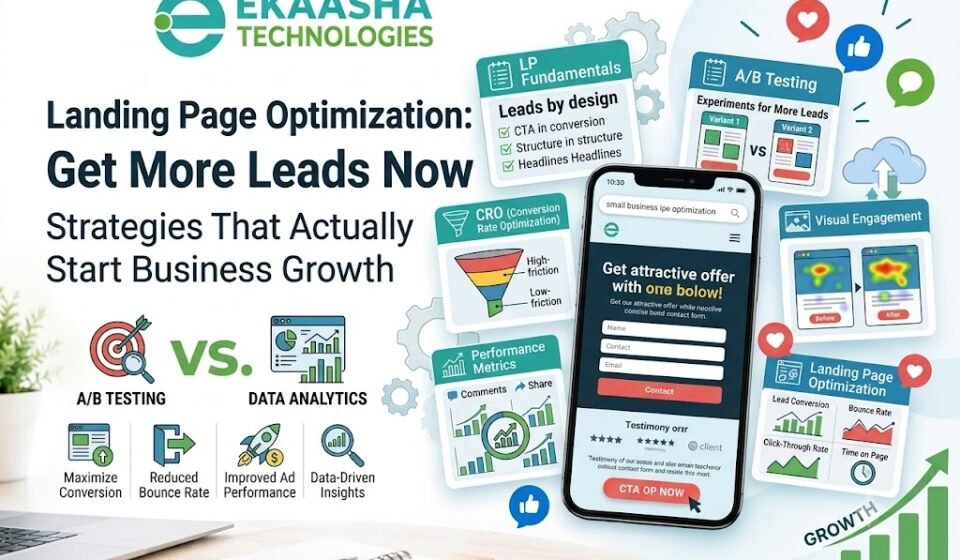

Generating website traffic is important, but traffic alone does not guarantee business growth. If visitors leave your website without taking any action, your marketing efforts may not produce the results you expect. This is where landing page optimization becomes important.
A well-optimized landing page can help businesses turn website visitors into leads, enquiries, registrations, or customers. By improving elements such as headlines, content, forms, calls-to-action, page speed, and trust signals, businesses can create a better experience for visitors.
In this guide, we will explore practical landing page optimization strategies that can support lead generation, improve conversion rate optimization, and help you create a high-converting landing page.
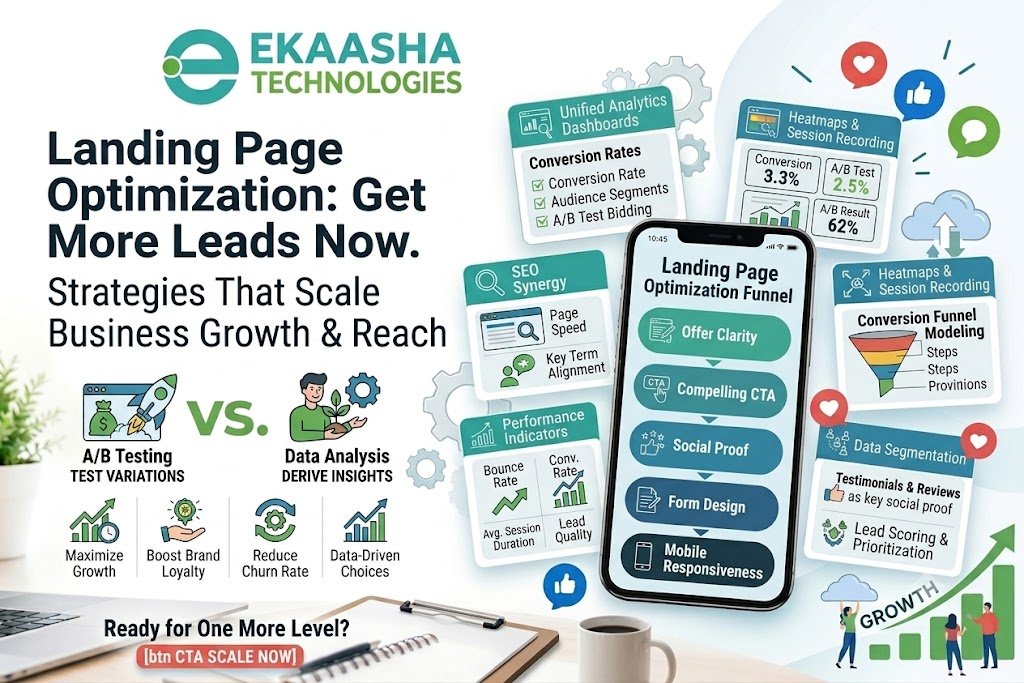
Landing Page Optimization: What Is It?
Landing page optimization is the process of improving a landing page to encourage visitors to complete a specific action.
This action could be:
- Filling out a contact form
- Requesting a quotation
- Booking a consultation
- Downloading an e book
- Registering for an event
- Signing up for a service
- Making a purchase
Unlike a general website page, a landing page usually focuses on one specific offer or goal.
For example, if a company is running Google Ads for a free consultation, sending visitors to a dedicated consultation landing page can provide a more focused experience than sending them to the homepage.
Landing Page Optimization for Better Lead Generation
One of the main purposes of landing page optimization is improving lead generation.
A landing page should quickly answer three important questions:
- What are you offering?
- Why should the visitor care?
- What should the visitor do next?
For example, instead of simply writing:
“Digital Marketing Services”
you could use:
“Get More Qualified Leads With Our Digital Marketing Services”
The second message focuses more clearly on the potential benefit.
A clear offer combined with relevant content can make it easier for visitors to understand the value of your service.
Write a Clear and Strong Headline
Your headline is one of the first things visitors see. Therefore, landing page optimization should start with a clear headline.
A strong headline should communicate the main value of your offer without making visitors search through the page for information.
Weak Headline:
“Welcome to Our Marketing Agency”
Better Headline:
“Grow Your Business With a Results-Focused Digital Marketing Strategy”
The second headline gives visitors a clearer idea about what the business provides.
Your headline should be simple, specific, and relevant to the audience that arrives on the page.
Use a Strong Call-to-Action
A call-to-action, commonly called a CTA, tells visitors what to do next.
Examples include:
- Get a Free Consultation
- Request a Quote
- Book a Demo
- Download the Guide
- Start Your Free Trial
- Contact Us Today
During landing page optimization, avoid using vague CTA text such as “Click Here” when a more descriptive option is possible.
For example:
Click Here ❌
Get Your Free Consultation ✅
A specific CTA helps visitors understand what will happen when they click the button.
Landing Page Optimization: Keep Your Lead Form Simple
Forms are an important part of lead generation, but complicated forms may create unnecessary friction.
If you only need basic information to contact a potential customer, you might ask for:
- Name
- Phone number
- Company name
- Requirement
Avoid asking for information that is not necessary at the initial stage.
However, the ideal form length depends on your business and the type of leads you need. A B2B business may require more qualification information, while a simple consultation request may need fewer fields.
This is why testing different forms can be an important part of conversion rate optimization.
Landing Page Optimization: Add Trust Signals
Visitors may hesitate to submit their information when they do not know or trust a business.
Adding genuine trust signals can help reduce uncertainty.
Consider including:
- Customer testimonials
- Reviews
- Case studies
- Client logos
- Certifications
- Awards
- Relevant business results
- Secure payment information, where applicable
For example, a testimonial can explain how a customer benefited from your service.
Always use authentic testimonials and accurate business claims.
A trustworthy high-converting landing page should make visitors feel comfortable taking the next step.
Landing Page Optimization: Focus on Benefits
Many businesses describe what their service does but fail to explain why it matters to customers.
Effective landing page optimization focuses on communicating benefits clearly.
Feature:
Monthly SEO Reports
Benefit:
Track your website performance and identify opportunities for improving organic traffic.
Features explain what you provide.
Benefits explain how the offer can help the customer.
Try to connect important features with practical outcomes that matter to your target audience.
Landing Page Optimization: Make Your Page Mobile-Friendly
Mobile experience is another important part of landing page optimization.
Visitors may access your landing page through smartphones after clicking an advertisement, social media post, email, or search result.
Make sure your landing page:
- Works properly on mobile devices
- Uses readable text
- Has easy-to-tap buttons
- Contains mobile-friendly forms
- Loads images efficiently
- Keeps important information easy to find
- Avoids intrusive pop-ups
A page that works well on desktop but is difficult to use on mobile can create unnecessary friction.
Landing Page Optimization: Improve Page Speed
Page speed can affect the user experience. Visitors may leave a page if it takes too long to load.
During landing page optimization, review elements such as:
- Large image files
- Unnecessary plugins
- Excessive scripts
- Third-party tools
- Poorly optimized videos
- Hosting performance
You can use Google’s PageSpeed Insights to check page performance and identify potential technical improvements.
[External Link Opportunity: Link “Google PageSpeed Insights” to the official Google PageSpeed Insights resource.]
Landing Page Optimization and Conversion Rate Optimization
Conversion rate optimization focuses on improving the percentage of visitors who complete a desired action.
For example, suppose your landing page receives 1,000 visitors and 50 people submit your enquiry form.
Your conversion rate would be:
50 ÷ 1,000 × 100 = 5%
Instead of focusing only on getting more traffic, businesses can also work on improving the percentage of existing visitors who convert.
You can test different:
- Headlines
- CTA buttons
- Images
- Offers
- Forms
- Testimonials
- Page layouts
- Content
This makes landing page optimization an ongoing process.
Landing Page Optimization: Test Different Elements
One of the best ways to understand what works for your audience is testing.
For example, you could test:
Version A:
“Get a Free Consultation”
Version B:
“Book Your Free Strategy Call”
You can then compare relevant conversion data.
Avoid changing every element simultaneously if you want to understand which change influenced the results.
Testing should be based on actual data rather than assumptions.
Landing Page Optimization: Common Mistakes to Avoid
Even a visually attractive landing page may perform poorly if it contains common conversion problems.
Avoid:
- ❌ Unclear messaging
- ❌ Too many CTAs
- ❌ Complicated forms
- ❌ Weak headlines
- ❌ Too much unnecessary content
- ❌ No customer proof
- ❌ Poor mobile experience
- ❌ Slow page loading
- ❌ Misleading claims
- ❌ No conversion tracking
Fixing these issues can create a clearer journey from visitor to lead.
Landing Page Optimization: How to Measure Results
Effective landing page optimization requires measurement.
Important metrics include:
- Page visitors
- Form submissions
- Conversion rate
- CTA clicks
- Cost per lead
- Qualified leads
- Traffic sources
- Revenue generated
For example, if 5,000 people visit your landing page but only 25 submit the form, you may need to investigate the page experience before simply spending more money on advertising.
Analytics can help you identify where visitors are dropping off and which elements may need improvement.
You can also read
SEO vs Social Media: Which Should You Choose?
Landing Page Optimization: Final Thoughts
Landing page optimization is not simply about making a page look attractive. It is about creating a clear and useful experience that helps visitors understand your offer and take the desired action.
A strong landing page should have a clear headline, relevant benefits, a focused CTA, a simple form, genuine trust signals, mobile-friendly design, and measurable conversion goals.
For small businesses, improving an existing landing page can support lead generation by helping convert more of the traffic they already receive.
Instead of asking only:
“How can I get more website visitors?”
also ask:
“How can I convert more of my existing visitors into leads?”
That question is at the heart of effective landing page optimization.