

Startup Website Development can help your new business build a professional online presence from the beginning. A well-designed website makes it easier for people to learn about your startup, explore your services, and contact you. It can also support SEO, mobile users, and future business growth.
Starting a business today usually means building an online presence too. Before contacting a new company, people may search for it, visit its website and look at what it offers.
For a startup, that first impression can matter.
A website can explain your business, introduce your products or services and give visitors a simple way to contact you. It can also help your startup look more established while you build your customer base.
This is where startup website development comes in.
One doesn’t have to begin with a massive site; rather, just design the site with the pages you’ll require when you get your first visitors.
In this article, we will cover the elements of an effective startup website, preparation prior to development, as well as mistakes to avoid.
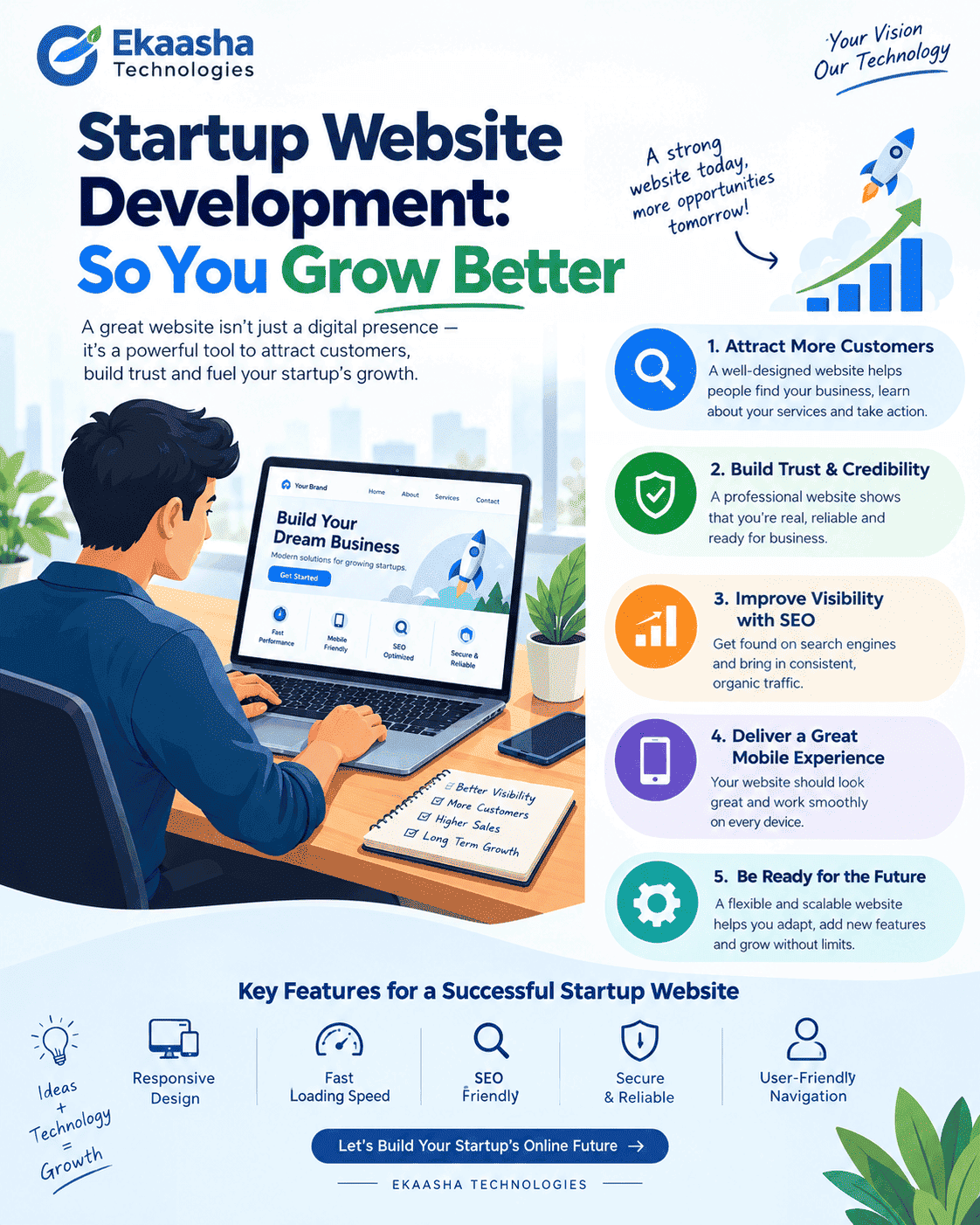
Startup Website Development: Where Should You Start?
Before choosing colours, layouts or development tools, think about the main purpose of your website.
What action would you like the visitors to take?
They may need to contact your company. Or maybe fill out a form, book a meeting, or purchase a product. In certain situations, the purpose of the website may be just to acquaint people with your startup and the services it offers.
For instance, for an e-commerce startup, you will have to develop product pages, shopping capabilities, and checkout options. For a local consultant company, you would need to create service pages, team information, and contact forms.
Therefore, the first thing you need is your business goal.
Once that is clear, it becomes much easier to decide which pages and features you actually need.
| Website Element | What It Does |
|---|---|
| Homepage | Introduces the business and its main offer |
| About Page | Explains the company and its background |
| Service/Product Pages | Gives visitors useful details |
| Contact Page | Makes it easy to get in touch |
| Blog | Provides useful information and supports SEO |
| Call to Action | Guides visitors toward the next step |
You may not need every item on this list. It depends on your startup and what you want the website to achieve.
Why Does Your Startup Need a Website?
New business has one clear disadvantage.
People might be unaware of its existence.
That is why potential customers usually seek additional information before making a choice. They can type your company’s name into the browser, compare your services to those of another business or even verify if your startup is real.
Professional website will provide people with all necessary information.
For instance, consider an example of a startup that provides digital services in Prayagraj. Potential customer might visit the website to learn about the services offered by your company, see samples of previous work and get the contact information.
With the right design, visitor will be aware of what he needs to do next.
However, unprofessional website can even ruin your reputation as a reliable business.
What Should a Startup Website Include?
There is no fixed structure that works for every business. However, a few pages are useful for many startups.
Homepage
Your homepage should quickly explain three things:
What do you offer? Who do you help? What should the visitor do next?
Keep the main message clear.
For example, a startup could say “Website Development for Small Businesses” instead of using a vague headline such as “Building the Future Together.”
The first version tells visitors what the business actually does.
About Page
The About us page can be used for presenting the founders, team, history and mission of your company. It does not necessarily have to be too lengthy. The idea here is to give the visitors enough information to learn about your company.
This page can also be used for telling people how you do business.
Service or Product Pages
If your startup offers several services, give each important service enough space to explain itself.
For example, a digital services startup might have pages for:
- Website development
- E-commerce development
- Website maintenance
- Digital marketing
These pages make navigation easier. They also give visitors more information before they contact you.
Contact Page
Make contacting your business simple.
Include the details customers actually need, such as your phone number, email address, business location and contact form.
If you serve customers in a particular city, make your service area clear too.
Keep Your Website Simple
A modern website doesn’t need dozens of animations or complicated effects.
Instead, think about the person visiting the page.
Can they understand what you do , find your services and see how to contact you?
For example, a clean layout with readable text and clear buttons can be more useful than a page filled with design elements that distract from the main message.
Also, don’t hide important information behind unnecessary clicks.
A visitor should be able to move through the website without having to figure out how it works first.
Make It Easy to Use on Mobile
A website can look great on a desktop and still be frustrating on a phone.
That matters because people often browse websites from smartphones. So, your website should adjust properly to smaller screens.
Buttons need to be easy to tap. Text should remain readable. Images should fit the screen without forcing users to scroll sideways.
For example, a contact form that works perfectly on a laptop may become difficult to use on a phone.
That’s why mobile usability should be considered during startup website development, not added at the end.
Don’t Ignore Website Speed
People don’t always wait for a slow page.
Large images, unnecessary scripts and poorly optimized files can slow a website down. As a result, a visitor may leave before seeing your main message.
This doesn’t mean your website should have no images or features.
Instead, use them carefully.
Compress large images, remove unnecessary elements and make sure each feature has a reason to be there. A faster website can also make browsing more comfortable for people using mobile connections.
Build SEO Into Your Website
Your website should be written for people first. At the same time, basic SEO should be considered during development.
Google provides guidance on making websites easier for search engines to understand and monitor, including its SEO Starter Guide and Search Console resources.
Some useful areas include:
- Clear page titles
- Helpful headings
- Descriptive URLs
- Relevant service pages
- Image alt text
- Internal links
- Useful content
- Mobile-friendly pages
For example, a website development company in Prayagraj could create a dedicated service page explaining its website development process, services and the types of businesses it works with.
If your startup targets a local market, you can also create useful pages around your service area.
However, don’t repeat the same keyword in every paragraph. Use it where it fits and let the rest of the writing sound natural.
Think About Future Growth
Startups can change quickly.
You may begin with two services and add more later. Perhaps you’ll launch an online store, introduce a booking system or create a customer portal.
Because of this, your website should leave some room for change.
You don’t have to build every future feature today. That can increase the cost and make the first version harder to manage.
Instead, build what you need now and choose a setup that can support sensible changes later.
Good startup website development should solve today’s problems without creating unnecessary problems for tomorrow.
What About Local Website Development?
If your startup serves a specific city, location can be part of your website strategy.
For example, a website development company in Prayagraj may want its website to clearly explain that it works with businesses in Prayagraj and nearby areas.
This could include:
- A clear service area
- Location information
- Relevant local service pages
- Useful local content
- Accurate contact details
The goal isn’t to add the city name everywhere.
Instead, use location information when it genuinely helps a customer understand where you operate and who you serve.
Common Website Mistakes Startups Should Avoid
Building a website is exciting, so it’s easy to focus too much on how it looks.
However, appearance isn’t the only thing that matters.
Some common mistakes include:
- Putting too much text on the homepage
- Making navigation difficult
- Ignoring mobile users
- Using poor-quality images
- Hiding contact information
- Adding features without a clear purpose
- Forgetting basic SEO
- Creating pages without a clear goal
- Not updating old information
For example, five animations won’t help if visitors still can’t understand what your startup offers.
Sometimes, a simple website is the better starting point.
FAQ: Startup Website Development
How much does startup website development cost?
The cost depends on the website’s size, design, features and development method. A simple business website will usually require fewer resources than an e-commerce store or a website with custom functionality.
How long does startup website development take?
There is no fixed timeline. A small website with ready content may take less time, while custom designs, integrations and advanced features can take longer.
Should a startup have a website from the beginning?
A website can give a new business a central place to explain its products or services. However, the right time depends on the startup’s goals, budget and stage.
Does a startup website need SEO?
SEO can help relevant people discover your website through search engines. Even if you don’t focus heavily on SEO at launch, a clean structure can make future optimization easier.
Should a startup build a website before launching?
It depends on the business. Some startups need a complete website before launch, while others can begin with a smaller site and expand it as the business develops.
You Can Also Read
Final Takeaway
Startup website development is not about building the biggest website possible.
It is about creating a useful online home for your business.
Start with your main goal. Then build the pages your customers actually need. Keep the design simple, make the website comfortable to use on mobile and consider SEO from the beginning.
As your startup grows, your website can grow with it.
If you’re looking for website development services in Prayagraj, Ekaasha Technologies can help you plan a website around your business goals, services and customers.



It’s great.. I read all of it
You’re doing absolutely great
Keep it up !
That’s awesome buddy. It’s really useful for a start in my business.
This is nice to build a web but detailed information is requested and if images and videos info could be added it would be really useful